
What Can NAD+ Therapy Do for My Health?
I see a lot on social media about NAD+. Is it a real thing? If so, what is it? What does it do? I am so confused. NAD+ is a coenzyme crucial for energy production, cellular repair, and overall health. As we age, NAD+ levels naturally decline, which can affect energy levels and brain function. NAD+ therapy, offered at Lone Star Center for Health and Wellness, helps replenish these levels, supporting anti-aging benefits, improving mental clarity, boosting energy, and enhancing overall wellness. For more information, contact us or request an appointment online. We serve patients from San Antonio TX, Alamo Heights TX, Balcones Heights TX, Leon Valley, TX, Terrell Hills TX, Windcrest TX, and surrounding areas.
What Is NAD⁺?
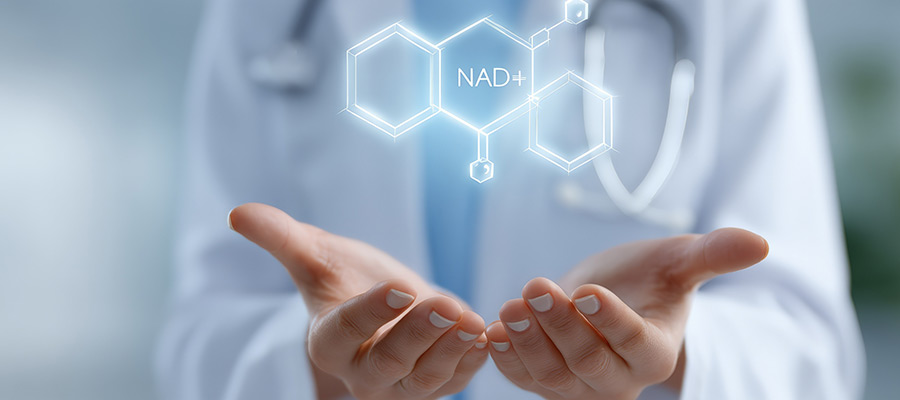
NAD⁺ (nicotinamide adenine dinucleotide) is a coenzyme found in every cell of the body. It’s essential for life because your cells use it to:
• Make energy
• Repair DNA
• Regulate metabolism
• Support healthy aging
Think of NAD⁺ as the cell’s power connector—without it, your cells can’t run efficiently.
How NAD⁺ Works in the Body
NAD⁺ has three major roles that are easy to understand, even without a science background.
1 Energy Production (ATP)
Your mitochondria—the “power plants” of your cells—use NAD⁺ to convert food into usable energy (ATP).
Low NAD⁺ = low cellular energy.
2️ DNA Repair & Cellular Protection
NAD⁺ activates enzymes (like sirtuins and PARPs) that repair DNA and protect cells from stress, toxins, and aging.
3️ Metabolic & Inflammatory Regulation
• Blood sugar pathways
• Fat metabolism
• Inflammatory responses
• Cellular communication
NAD⁺ helps regulate:
This is why NAD⁺ is often discussed in the context of longevity, resilience, and metabolic health.
Why NAD⁺ Levels Decline
NAD⁺ naturally decreases with age—sometimes by more than half by midlife. Levels also drop due to:
• Stress
• Poor sleep
• Alcohol
• Inflammation
• Illness
• High-sugar or high-fat diets
Lower NAD⁺ is associated with fatigue, slower recovery, and reduced cellular efficiency.
Why People Take NAD⁺
You don’t typically take NAD⁺ directly by mouth because it isn’t absorbed well. Instead, people use:
• Precursors (NMN, NR, niacinamide)
• NAD⁺ IV therapy
• NAD⁺ injections
These approaches bypass or support the digestive system and help raise NAD⁺ levels.
NAD⁺ Injections — Administered Under Medical Supervision
NAD⁺ injections are a clinical method of delivering NAD⁺ directly into the body, usually intramuscularly (IM) or intravenously (IV).
Because NAD⁺ affects cellular metabolism and can influence how people feel during administration, these injections should only be given under medical supervision.
• Proper dosing
• Screening for contraindications
• Monitoring for discomfort or reactions
• Safe technique and sterile handling
Medical oversight ensures the following:
This is especially important for IV NAD⁺, which requires trained clinical staff.
What People Hope to Support with NAD⁺
While research is ongoing, individuals often seek NAD⁺ support for:
• Energy and fatigue
• Cognitive clarity
• Healthy aging
• Metabolic efficiency
• Recovery from stress
• Cellular resilience
These are wellness-oriented goals—not treatments for medical conditions
We offer NAD+ injections and IVs. Contact us today for more information.
References (APA 7.0 Format)
Canto, C., & Auwerx, J. (2012). NAD⁺ as a signaling molecule modulating metabolism. Cold Spring Harbor Symposia on Quantitative Biology, 76, 291–298. https://doi.org/10.1101/sqb.2012.76.010439 (doi.org in Bing)
Covarrubias, A. J., Perrone, R., Grozio, A., & Verdin, E. (2021). NAD⁺ metabolism and its roles in cellular processes during ageing. Nature Reviews Molecular Cell Biology, 22(2), 119–141. https://doi.org/10.1038/s41580-020-00313-x (doi.org in Bing)
Fang, E. F., Lautrup, S., Hou, Y., Demarest, T. G., Croteau, D. L., Mattson, M. P., & Bohr, V. A. (2017). NAD⁺ in aging: Molecular mechanisms and translational implications. Trends in Molecular Medicine, 23(10), 899–916. https://doi.org/10.1016/j.molmed.2017.08.001 (doi.org in Bing)
Grozio, A., Mills, K. F., Yoshino, J., & Imai, S. (2018). NAD⁺ metabolism: Pathways, regulation, and roles in cellular functions. In S. Imai & L. Guarente (Eds.), The NAD⁺ Metabolism and Signaling (pp. 1–29). Springer. https://doi.org/10.1007/978-981-10-6107-3_1 (doi.org in Bing)
Lautrup, S., Sinclair, D. A., Mattson, M. P., & Fang, E. F. (2019). NAD⁺ in brain aging and neurodegenerative disorders. Cell Metabolism, 30(4), 630–655. https://doi.org/10.1016/j.cmet.2019.09.001 (doi.org in Bing)
Rajman, L., Chwalek, K., & Sinclair, D. A. (2018). Therapeutic potential of NAD⁺-boosting molecules: The in vivo evidence. Cell Metabolism, 27(3), 529–547. https://doi.org/10.1016/j.cmet.2018.02.011 (doi.org in Bing)
Verdin, E. (2015). NAD⁺ in aging, metabolism, and neurodegeneration. Science, 350(6265), 1208–1213. https://doi.org/10.1126/science.aac4854 (doi.org in Bing)
Yoshino, J., Baur, J. A., & Imai, S. (2018). NAD⁺ intermediates: The biology and therapeutic potential of NMN and NR. Cell Metabolism, 27(3), 513–528. https://doi.org/10.1016/j.cmet.2017.11.002 (doi.org in Bing)
Zhang, H., Ryu, D., Wu, Y., Gariani, K., Wang, X., Luan, P., … Auwerx, J. (2016). NAD⁺ repletion improves mitochondrial and stem cell function and enhances life span in mice. Science, 352(6292), 1436–1443. https://doi.org/10.1126/science.aaf2693 (doi.org in Bing)



 Send Text
 How May I Help You?